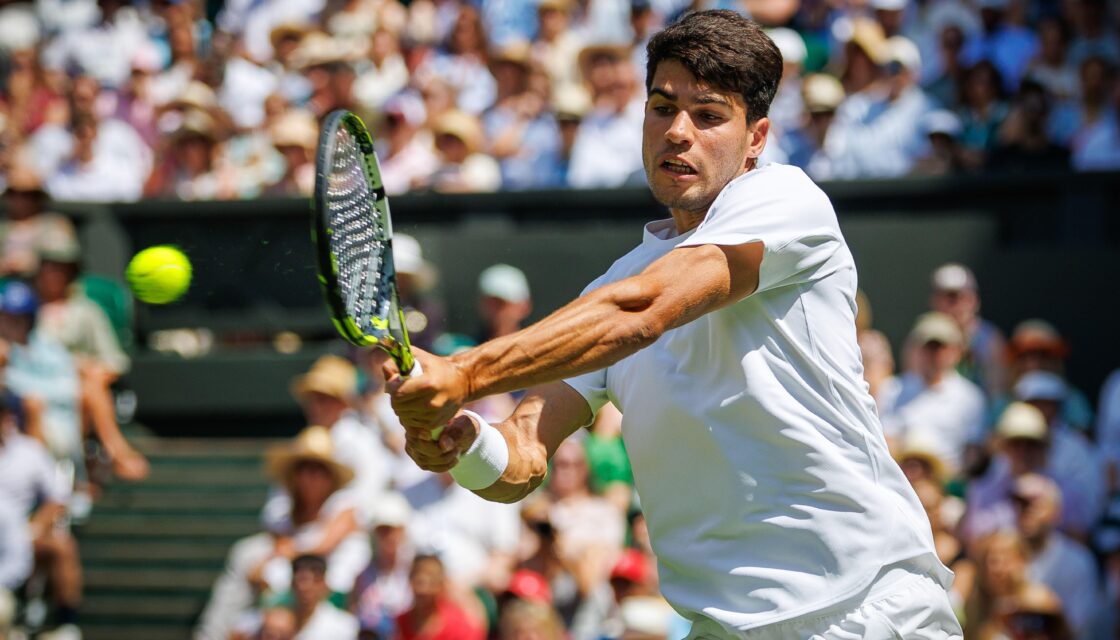
Carlos Alcaraz had a chance to serve his way clear of Daniil Medvedev in Vienna and lost four points running. This was the second set. In the first he had broken Medvedev for a second time at 5–4 to take the set. Now Medvedev was back on serve and went on to take the first point of the tie-break. Alcaraz won seven of the next eight, largely from the back of the court.
They meet again in Turin on Wednesday, 18 November, no earlier than 2pm CET. In their ATP Finals openers at the Inalpi Arena on Monday, 16 November, Alcaraz beat Frances Tiafoe 6–2, 6–2 and Medvedev beat Flavio Cobolli 7–6(4), 6–3.
Alcaraz’s first serve made the difference in Vienna
Medvedev came to their 31 October semi-final on a seven-match winning run and lost it 6–4, 7–6(2). Both men managed a break in each set. Four break points might not sound like much for two sets, but Alcaraz took three of them. His groundstrokes carried him through the tie-break.
Medvedev saw plenty of serves he could do very little with. Alcaraz won 35 of his 45 first-serve points. His second serve won him only about four in ten, though.
What Medvedev gives up by standing deep
There is a reason Medvedev gives up several metres of court to receive a first serve. He gets longer to read the flight and take a full swing. A deep enough return still has Alcaraz moving backwards for his first groundstroke.
The wide serve can leave Medvedev both a long way back and well off to one side. At Indian Wells in 2023, Alcaraz hit drop shots into the space in front of him and came straight in behind some of his serves.
Give Alcaraz a short forehand, and he can hit into the open court or drop the ball short. He has little room for either shot if the return comes back deep down the middle.
Medvedev does come in a step or two to return on occasion. By his own account, it depends on the conditions. On a second serve here, that would give Alcaraz a little less time to set his feet.
Paris showed what happens when the first serve falters
Alex de Minaur has twice lost an indoor final to Alcaraz. Rotterdam in 2025 was the first indoor title of Alcaraz’s career. Vienna this autumn was followed by his first Paris Masters, and Tiafoe was the tenth man he’d beaten in succession. Matteo Berrettini withdrew before they played in Paris.
Taylor Fritz had two match points in their Paris quarter-final. Alcaraz saved both. A break down to Ben Shelton in the second set of the final, he kept the return in play long enough to get a ball he liked on the forehand. That wing supplied the winners that got him back to 4–4 in a 7–6(5), 7–5 win.
Tiafoe had one game in which he might have turned the second set. At 3–2 in the second set Alcaraz had to save three break points to stay ahead. The trouble for Tiafoe was what happened on his own service games. Twelve times he needed a second serve and Alcaraz took all 12 points.
There’ll be fewer of those openings if Medvedev serves as well as he did against Cobolli. He won 34 of 41 first-serve points that night and said afterwards how fast the Turin court was. Alcaraz had much the same problem with his serve in losing to him at Indian Wells in March. One break might do it for Medvedev in a set like that.
How the winner can reach the semi-finals
Tiafoe can put Alcaraz through on Wednesday evening by beating Cobolli, provided Alcaraz has beaten Medvedev first. An Alcaraz win in straight sets also does it if Cobolli wins in three.
For Medvedev, the result he wants in the evening, should he beat Alcaraz, is a Cobolli win. If it’s Tiafoe who wins, Medvedev can still go through, but only if Tiafoe needs three sets and Medvedev has won in two.
The point to look out for is a second serve when Alcaraz is up against it. Watch where Medvedev stands and how much ground Alcaraz gives up after the return. Medvedev broke twice in Vienna. Keeping the next forehand behind the baseline is how he can give himself another chance.